The Growing Backlash Against Roblox
The pressure increases - lawsuits, regulations, bans, media exposés

The popular online gaming platform Roblox is the largest metaverse platform in the world. With a daily user count of around 90 million, roughly 40% of which are under the age of 13, the company is now responsible for the safety of millions of children every hour of the day.
Unfortunately Roblox has acquired a very poor reputation amongst safety researchers, activists, parent groups and, increasingly, policy makers. Some of the reasons for this include Roblox’s history and response to:
Poorly moderated games being made accessible to children (Public Bathroom Simulator, Dollhouse Roleplay)
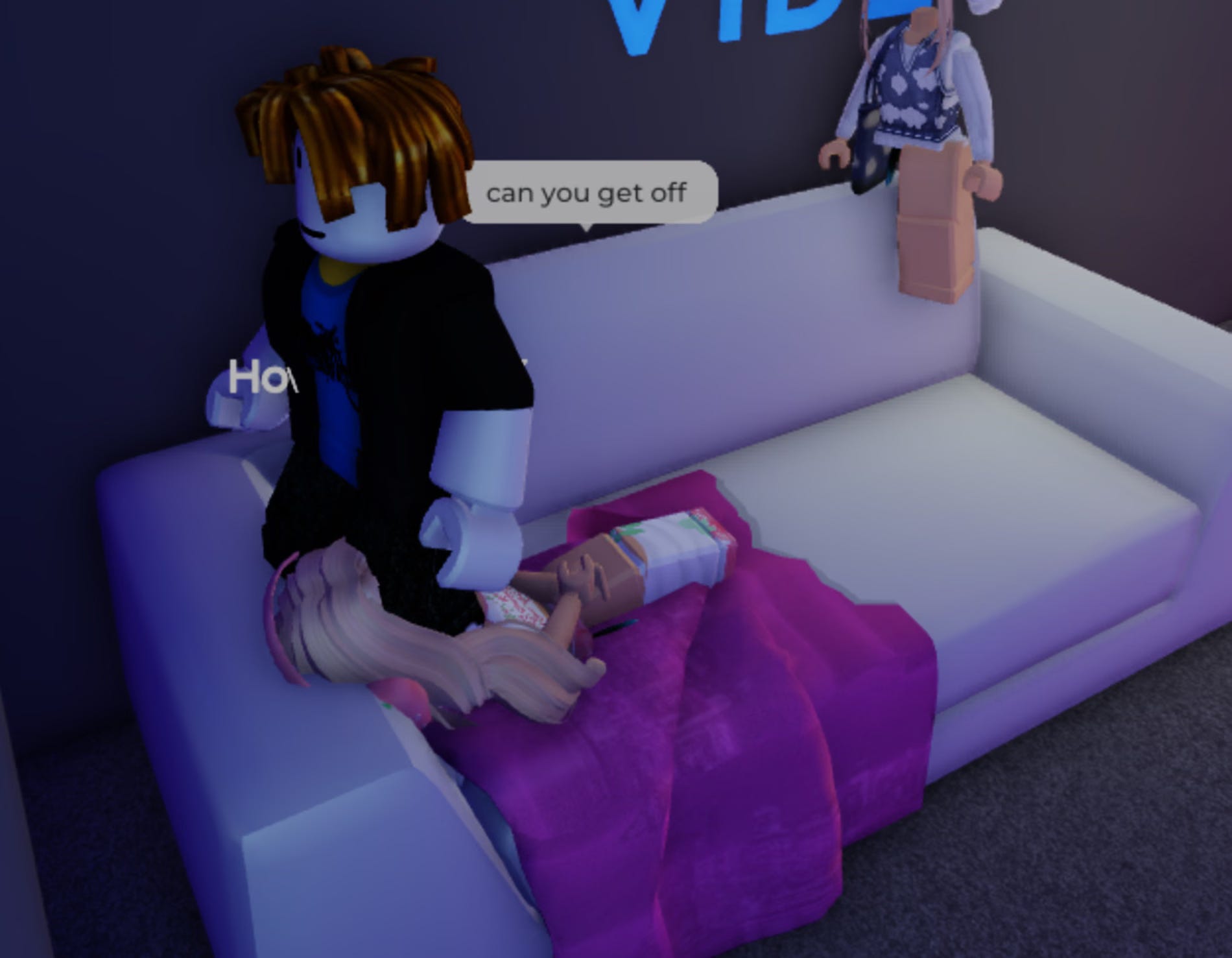
Allowing games and users to simulate sexualised activity with children
Facilitating adults and children physically meeting one another
Chat-based abuse, harrassment, bullying, the sending of obscene material
Organised child grooming, self-harm, violent or animal-abuse promoting groups using the platform to target minors
Exploiting child labour to make and manage the games users play on the platform
Heavy use of in-game advertising, microtransactions and gambling mechanics, as well as allowing illegal third-party casinos to target children
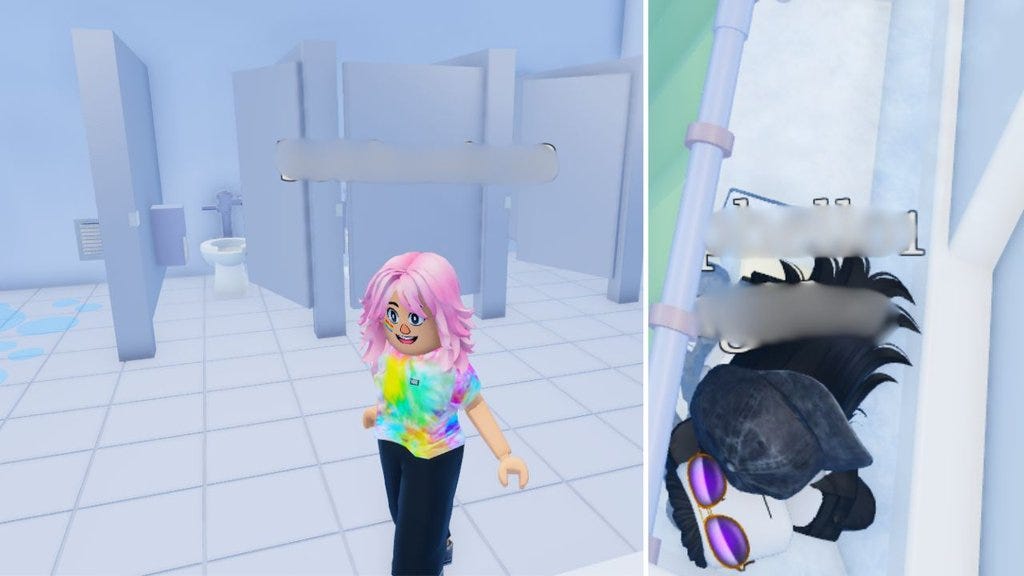
The most damning report against the company was released by Hindenburg Research on Oct 8th 2024. The report authors stated bluntly that Roblox was lying about its user figures, time spent on games and its concern for child welfare, or even simple legality at all. Some of their findings revealed:
A total lack of age partitioning and content blocking for child accounts
Rampant violence, abuse, degradation and illegal content within many Roblox games, including simulators for killing pregnant women, assualting homeless people and shooting people in hospital
Easily accessible servers and games where child pornography was displayed and traded, minors simulated sex acts on adults in exchange for Robux currency and sexual content was made for external ‘Roblox porn’ sites
Frequent interactions with avatars named after infamous child molestors and paedophiles
This report went on to produce the now-infamous quote:
Beyond inflated key user metrics, our in-game research revealed an X-rated pedophile hellscape, exposing children to grooming, pornography, violent content and extremely abusive speech.
Roblox has always been vocal about child safety, and insists that steps have been taken towards more stringent moderation. Yet its critics point out the company’s consistent prioritisation of game expansion, player retention and profit over and above protecting its vulnerable users. Roblox has been so lax in many people’s eyes that anti-paedophile vigilantes and groups have formed on the platform, aiming to highlight and remove known predators where the company will not. Furthermore, Roblox’s aggressive response to in-game vigilantism further highlights their unwillingness to tackle threats to their child users.
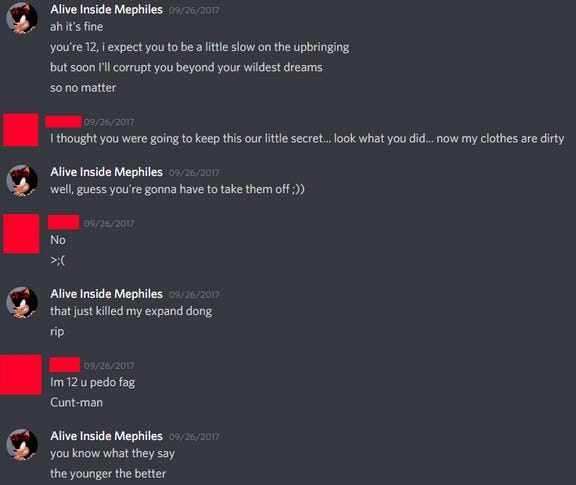
Campaign pressure since the Covid lockdowns has grown, and mainstream media reporting has caught up with online concerns discussed across social media. As of 2025 Roblox has found itself:
Banned in Algeria, China, Iraq, Jordan, Kuwait, North Korea, Oman, Qatar, and Turkey. Many other countries have imposed regulations and issued police warnings to the public about child safety on the platform.
The subject of multiple legal challenges, including US class action lawsuits and state level investigations, primarily asserting that Roblox knowingly failed to protect children who were then abused or exploited via the platform.
Accused of facilitating abuse which has led to violent and even fatal consequences for users
Listed as a host and safe space for extremist and radical groups, even allowing the promotion, roleplay and glorification of extremist ideologies.
Recent headline pieces include The Guardian’s “My chilling week on Roblox: sexually assaulted and shat on as a child avatar roaming the online world”, and New York Magazine’s “The world’s most beloved video-game app is also a brain-rotting, hypercommercial dystopia”
In one game – a vibe hangout where I am logged in as a 13-year-old – it doesn’t take long for another avatar to sexually assault me. He sits on my face and repeatedly thrusts his hips while I implore him to leave me alone.
A group of male avatars later call me an “ugly bacon dirty gross girl” in reference to the bacon-like hair on my rookie default avatar.
In another popular role-playing game – Berry Avenue – someone follows me around and pretends to shit on my head and face, calling me a toilet.
- Sarah Martin, The Guardian (05/11/25)
At current rates, spending $200 will get you 24,000 Robux. But converting 24,000 Robux a kid has earned diligently building and selling a game nets them only $91. The whole dynamic — encouraging children as young as 13 to do computer work, taking most of their earnings, and paying the rest in scrip — “would be illegal if it weren’t happening online,” Smith argued.
-Sam Biddle, New York Mag (09/09/25)
In a piece by The Times, reporters and investigators found worrying amounts of far-right, anti-semitic and Islamist material on Roblox, including avatar names, flags, icons and even recreational games of massacres and historical violence. All aimed at very young children.
Recreations of Auschwitz and usernames espousing support for Houthi militants demonstrate the danger of ‘youth radicalisation’ via gaming platforms…
The study found that Roblox was “exploited by malign actors” and hosted “playable recreations of mass shootings, content glorifying Nazi Germany and right-wing extremist groups”, adding: “Even recruitment into right-wing extremism has taken place on Roblox.”
-Matt Dathan, The Times (02/11/25)
The Australian outlet 7News published a piece in september entitled “Teen gamer reveals sickening scenes on Roblox as eSafety Commission announces new commitments to combat grooming”. In it, online safety educator Kirra Pendergast described some of the workshops she has held in schools with children who regularly play Roblox:
“If I ask a room full of kids whose been asked to be someone’s boyfriend or girlfriend (on Roblox), most of the room will put their hand up, and they’re all giggling because its quite normal,” she said.
Similarly, when she asks children whether they’ve received requests to roleplay, or have been offered Robux (Roblox currency) to “do something,” she said: “Hands go up every single time.” …
… after a school talk she gave about the platform, a little girl approached her.
“She kept tapping herself on the chest and saying: ‘It happened to me, it happened to me’. She described being coerced into a sexual assault so graphic that the principal standing beside me wobbled,” Pendergast said.
“I grabbed her by the arm, so she didn’t fall on the floor.”
-Hayley Taylor, 7News (21/09/25)
Similar pieces have appeared all around the world, from Indonesia to Russia. One South African article published in October was bluntly entitled “Roblox: Like handing your child to paedophiles on a platter”
Roblox’s response to this new wave of criticism and lawsuits has been a confused mix of directions. The company announced the formation of a Parent & Caregiver Council, to help shape policy and ‘champion civility’. Almost every week they issue a new set of safety strengthening protocols and features, such as the incoming facial age estimation technology, to ensure mature games and conversations do not include minors.
However, when challenged over his company’s child safety record, CEO Dave Baszucki told BBC News “My first message would be, if you’re not comfortable, don’t let your kids be on Roblox.” He denies that Roblox ignores users attempting to move conversations onto Discord and elsewhere (a constant feature of child exploitation cases on the platform), and has pushed on multiple occasions for Roblox to include a dating feature , a move so tone-deaf it prompted immediate outrage. As PC Gamer put it - “Roblox CEO horrifies every parent alive with his ambition that the platform become a dating hub”.
While most online games and platforms face some level of criticism over child safety, Roblox is in a category of its own. A platform where the games are designed and often run by and for children, with probably the internet’s largest child userbase, which allows users to join anonymously and meet other players with little oversight. This level of child insecurity should warrant a stringent set of safety features, but Roblox appears doggedly committed to expanding at all costs.
As the National Centre on Sexual Exploitation explained back in July 2024, Roblox has major child safety flaws, including: a lack of age verification, inadequate content filtering, limited visibility for parents, limited customization to block, curate etc, insufficient guidance for parents, a lack of transparency and complex child safety features (such as they exist). The organisation concluded:
As of May 10th, 2024, Roblox Corporation’s market cap is over $20B, and certainly has the financial capacity to implement more comprehensive child safety measures. The corporation’s moral compass is directed toward profitability, sacrificing child safety across the globe.
As the lawsuits mount up and policymakers turn their attention towards digital ID and age verifications laws, Roblox seems somehow immune to real change. Every parent safety group and internet research team agrees that Roblox is amongst the most risky platforms for children to experience online, especially unsupervised. As a result a number of players have formed groups to actively seek out child predators on Roblox, with the goal of having them removed, and if the evidence is present, having them targeted by law enforcement. These ‘vigilantes’ have caused enough controversy to become mainstream news across the world. One figure in particular, a man with the account name ‘Schlep’, has been very vocal in his persistence to have predators removed from the platform. As a result he was issued with a cease-and-desist letter from Roblox on August 10th 2025, threatening legal action against him, and had his account(s) terminated.
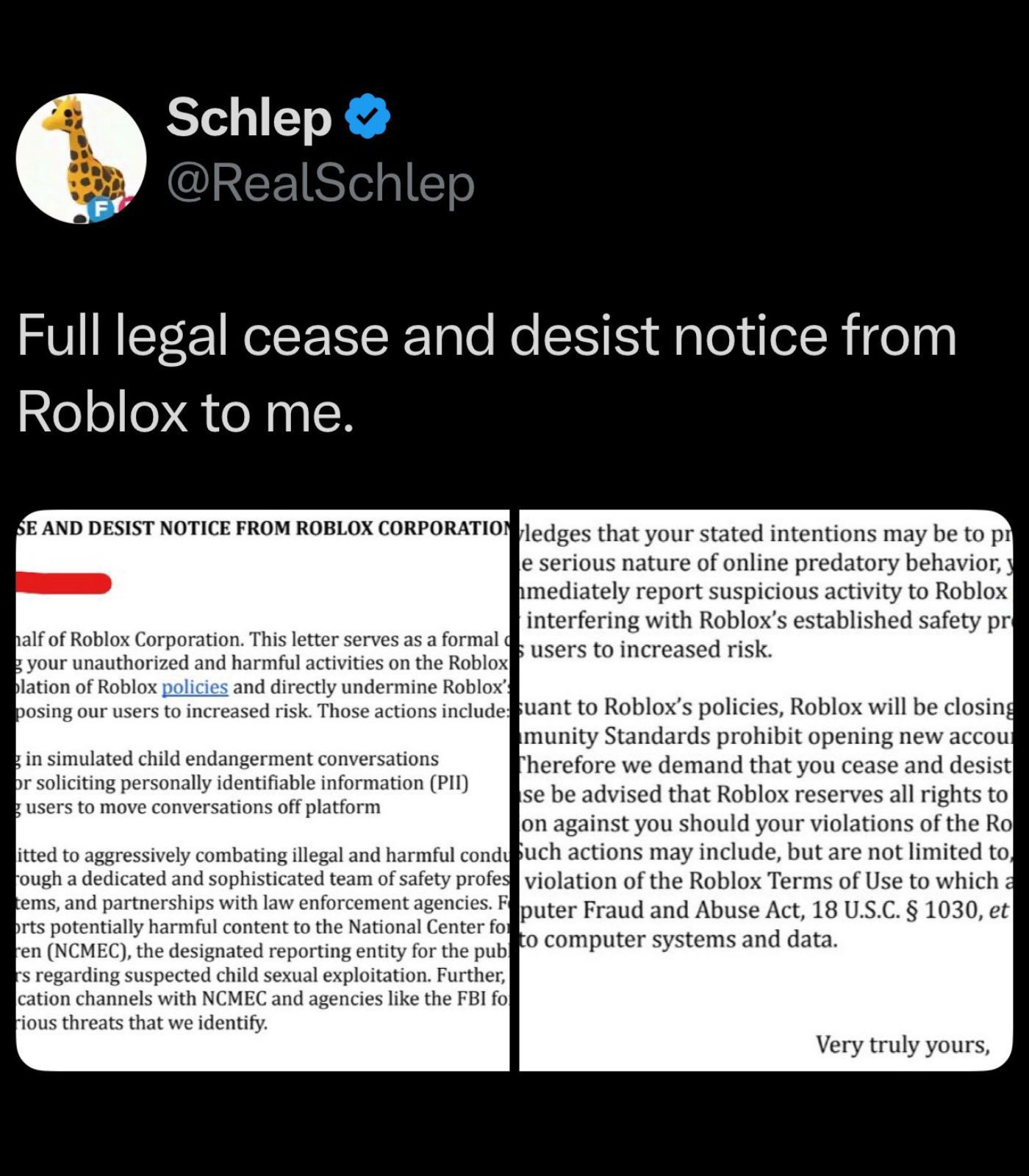
On August 13th, Roblox published an explanation for their removal of Schlep and other vigilantes, citing legal concerns over adults impersonating children in order to catch predators, following this up with a statement to Lousiana’s KPLC on August 14th:
Taking the law into your hands isn’t safe in the real world and it’s not safe online. That’s why we work with law enforcement to hold bad actors accountable. Many experts agree independent actors impersonating others and luring users to other platforms for sexually explicit conversations can never be safe.
Unfortunately for Roblox their timing could not have been worse. The next day Lousiana’s Attorney General filed a child protection lawsuit against them, accusing them of facilitating child predator contact with minors.
“Due to Roblox’s lack of safety protocols, it endangers the safety of the children of Louisiana,” Attorney General Murrill stated. “Roblox is overrun with harmful content and child predators because it prioritizes user growth, revenue, and profits over child safety.”
August 15th didn’t get any easier for them, as online petitions to give Schlep his account back grew, along with calls for Roblox’s CEO to resign. Schlep has widespread support amongst prominent YouTubers, Roblox players and the online gaming/content communities. US Congressman Ro Khanna also reached out to Schlep and began another petition, to force Roblox to take child safety seriously.
The journalist Chris Hansen, from To Catch A Predator, then confirmed that he was making a documentary about Roblox and child safety, and that Schlep was a part of the project. Roblox has since attempted to make public climbdowns and invited Schlep back to work with them, but he has confirmed that he will not and these outreach statements are merely PR.
Overall 2025 has been a very bad year for Roblox’s public image and reputation. It has found itself continually on the defence, with journalistic article after article, reports, YouTube video attacks and widespread unwanted attention due to Schlep and other vigilantes. Alongside this the company faces subpoenas and potentially hundreds of lawsuits in the US. In at least one recent case, the Roblox legal team attempted to force the dispute into a private hearing, rather than face public court - a motion the judge denied. Beyond criminal and civil proceedings, Roblox is now appearing on governmental radars around the world in 2025, including:
A Dutch governmental investigation, a ‘Child Rights Impact Assessment’ of Roblox
As part of a US Securities and Exchange Commission investigation into market manipulation
Over 250 FBI investigations concerning extremists and organised groups which target children and coerce them into committing sexual acts, self-harm, animal abuse, school shootings and suicide
As the main target of New York’s Children’s Online Safety Act, which would legally force Roblox to comply with contemporary child safety standards in gaming
Being investigated by the UK’s Independent Reviewer of Terrorism Legislation. The lead lawyer of the report explicitly concluded that parents, children and teenagers “should not be using” Roblox
It seems likely that 2026 will bring increased difficulties for Roblox, and potentially see the platform banned or heavily regulated in the US and many European countries. By refusing to engage with the most basic requests for child protection early on, the world is waking up to the immense damage and harm Roblox has allowed to happen on its platform, and how little it seems to care.