Emerging Trend On YouTube - Hyperviolent Thumbnails?
AI plus morbid curiosity equals huge views, rape and torture sells on YouTube

— All the images shown here, although disturbing, were either generated by artificial intelligence or partially drawn out by hand —
Although you might search online using words, chances are you’ll select your target through a small mixture of text and graphics - a thumbnail.
For YouTube creators thumbnails are everything, they may spend hours or days crafting the perfect image and text combination to be eye-catching, interesting and different.
With the pressures of a very crowded marketplace for attention and retention time online, some creators have resorted to increasing levels of shock-value in order to hook in their viewers. Exaggerated features and titles like “I CAN’T BELIEVE THIS IS REAL”, or “THE WORST WAYS TO…”, aim to grab you and demand you click on the video.
At DigiShield Kids we proactively monitor trends like these, in order to raise awareness and educate parents, teachers, safeguarding leads, academics and the general public as to what novel dangers and risks are trending online.
We’ve noticed over the past year, and especially the past month, a rising trend of Hyperviolent AI-driven Thumbnails being used to funnel viewers towards topics such as:
Gory deaths (rollercoasters, car accidents, pranks)
Depictions of increasingly shocking criminal murders (mafia, Mexican cartels)
Historical capital punishment and torture (medieval Europe, Rome, the Mongols)
Intensely sexualised depictions of historical violence towards women
Sexually graphic/sensationalised depictions of historical medical violations against women
What these all have in common is the use of non-real yet realistic imagery to bypass normal filters and standards for YouTube content. The imagery can be very low quality and almost comical, sometimes the same image will be recycled with different captions.
Other accounts have mastered using more photorealistic AI imagery to make genuinely unnerving yet surreal pictures of spectacular violence. Finally, some accounts use handdrawn or partially handdrawn cartoon images, often showing two human heads against a white background, each one undergoing a graphically violent death.
Let’s see some examples.
Human-made cartoons
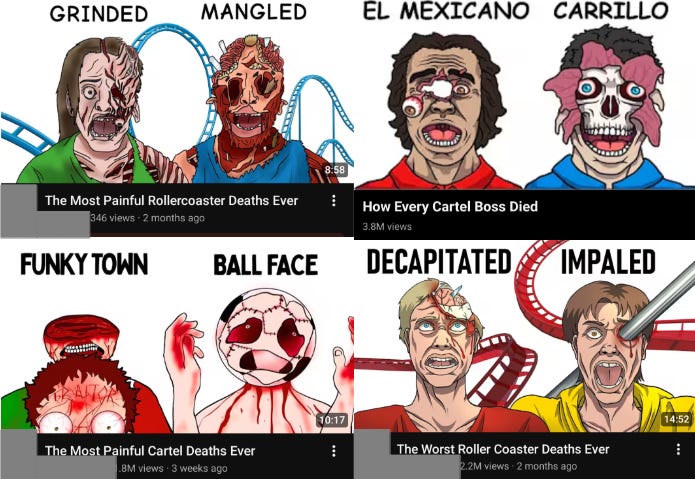
AI-driven: shock, pranks

AI-driven: capital punishment

AI-driven: sexual violence against women

AI-driven: bizarre, surreal, disturbing

As these images clearly show, AI-driven thumbnail generation (and often video content itself) is becoming extremely graphic, sexualised and sensational. Sexual violence towards women is being shown far more explicitly than a typical historical or academic video would depict. In particular the eye-grabbing facial expressions of pain and fear go far beyond what YouTube allows, let alone the violent context, crowds of onlookers and other disturbing additions such as animals.
As YouTube’s thumbnail policy states:
Don’t post a thumbnail or other image on YouTube if it shows:
Pornographic imagery
Sexual acts, the use of sex toys, fetishes or other sexually gratifying imagery
Nudity, including genitals
Imagery that depicts unwanted sexualisation
Violent imagery that intends to shock or disgust
Graphic or disturbing imagery with blood or gore
Vulgar or lewd language
A thumbnail that misleads viewers to think they’re about to view something that’s not in the video
Note: The above list isn’t comprehensive.
What are the risks to children?
So far we have not detected any of these examples or video types on YouTube Kids, under any age setting - which is encouraging.
Using a completely fresh standard YouTube account, we were able to find these videos within one or two clicks with search terms of children/historical interest, eg:
“kids medieval history” → amongst the returned results “Imagine Being 7 and Tortured: Medieval Child Punishments Explained”
“school project rome gladiators” → returned “Roman Gladiator School Exposed Secrets They Don’t Want You To Know”
“kids victorian medicine” → returned “The DARK Truth Behind Victorian Medicine” with this thumbnail (below)
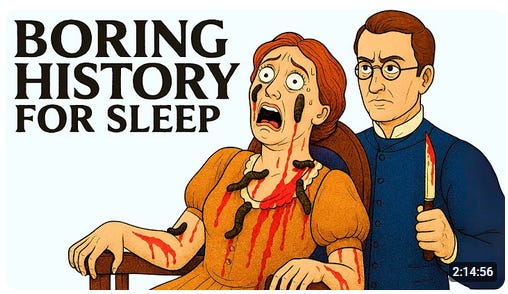
“tudor era school essay” → returned numerous AI-driven videos about ‘disturbing’ facts, ‘secrets’ and ‘brutal deaths’, with unpleasant or grotesque thumbnails
Once we clicked on any AI-driven thumbnail, the recommendation bar offered up more and more extreme content. A simple search looking for information about the Tudor eventually turned up some disturbing results IF we clicked through AI content 2-3 times.
A search like “tudor era school essay” went to “Why You Wouldn’t Survive Life in Tudor England” → “The Horrific Final Days of King Henry VIII” → “William Wallace’s Brutal Execution Was Worse Than You Think” → “5 Sexual Atrocities That Defined Emperor Caligula” → “What Vikings Did To Christian Nuns Was Worse Than Death” and so on.
Each video had similar thumbnails to our examples above.
Therefore, a school age child given access to YouTube in order to look up homework content, or even asked by the school to look up history videos, may easily stumble across photorealistic depictions of sexual violence, torture and execution.
What can parents do?
A few suggestions as to what parents can do?
For preschool and young primary school children we recommend installing YouTube Kids rather than YouTube itself
Use YouTube’s control panel to manage your video feed:
Disable autoplay
Disable recommendation bar
Use the ‘not interested’ flagging to see if AI-driven content will stop being shown
Turn off or reduce YouTube Shorts, as this content is usually of a lower quality
Use ‘likes’ tactically, to encourage less AI content
Violent thumbnails are not permitted under YouTube’s policies, and they can be reported for violating terms and conditions. Consider reporting any such videos you find.